When ‘Doing the Work’ Isn’t Enough: Guilt, Healing & the Human Timeline
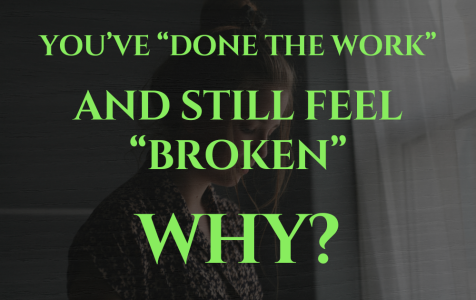
You’ve done the therapy. You’ve read the books. You’ve journaled, meditated, breathed through it, and cried through it.
And yet, you still feel off…
You thought you’d be further along by now. That you’d have found peace, clarity, or at least some relief.
Instead, you feel like you’re back in the same stuckness, only now with a new layer of guilt.
Because you should be okay by now, right?
Why Do You Still Feel Broken After All the Healing?
There’s a silent expectation in the personal growth world that once you’ve “done the work,” you should be free of your pain. That self-awareness will automatically lead to self-liberation. That all these heavy feelings work must get you all the calm and joy now! That it should all be better now. No, not better, it should be great, perfect! But…it isn’t, is it? So what’s really happening? Let’s explore a bit, shall we?
(Self-)Awareness doesn’t always equal relief.
In fact, sometimes becoming more aware of your patterns, triggers, and traumas amplifies the discomfort.
As Gabor Maté says:
“The more aware you become, the more pain you may initially feel. Because now, you’re no longer numb.”
When you awaken to what’s been living under the surface, it can feel like things are getting worse before they get better.
You’re not broken (like that can ever happen?! It can’t – you don’t “break.” You hurt, yes. You feel lost, yes. You go down the worst rabbit holes, yes. AND, you don’t ever break.)
What’s likely happening is that you’re becoming present.
The Trap of Healing Guilt
Guilt sneaks in through the back door of growth. It whispers:
- “Why are you still crying about this?”
- “You’ve had enough therapy. Get over it.”
- “Others have it worse. Be grateful.”
This voice isn’t your truth. It’s a protective mechanism, shaped by a culture that worships productivity, quick fixes, and linear progress.
But healing isn’t linear. And guilt is not a reliable signpost. It’s often a trauma echo – a reflection of early experiences where your emotions were invalidated.
So when guilt arises on your healing path, it’s not proof you’re failing.
It’s proof that you’re feeling.
Your Nervous System Doesn’t Care About Timelines
One of the biggest misunderstandings in healing work is the belief that emotional recovery should be tied to chronological time.
- “It’s been three years since the breakup.”
- “I went no-contact months ago.”
- “I already processed this memory in therapy.”
But your nervous system doesn’t measure time the way your mind does.
It measures safety.
Until your body feels safe enough to release a pattern, it will hold on. Not to punish you, but to protect you.
As Deb Dana writes:
“The nervous system’s first priority is survival, not healing. Healing happens when safety is consistent.”
This means that sometimes, even after “doing the work,” your body is still waiting for signals that it’s truly safe to let go.
And that takes time. Often, more than we want it to.
Integration Takes Longer Than Insight
Breakthroughs are fast. But integration is slow.
This slower unfolding reflects the science of neuroplasticity – the brain’s capacity to rewire itself through repeated experiences, not one-time insights.
A PsychCentral article reads, “Childhood trauma can have a lasting effect on physical and mental health. But with the help of neuroplasticity, healing is possible.”
You might have a profound realization in a coaching session or during a meditation.
But applying that insight in your day-to-day life, especially when you’re triggered, is where the real healing happens.
Integration looks like:
- Noticing the same trigger, but choosing a different response
- Pausing when your old patterns want to react
- Breathing instead of blaming
- Choosing presence instead of panic
These are micro-moments of transformation.
They often go unseen, uncelebrated, and undervalued.
But they are the evidence that the work is working, just not in a flashy, overnight-success kind of way.
What If the Setback Is the Work?
What if the spiral you think you’re stuck in is actually a deeper layer of the same wound, surfacing for integration?
Healing doesn’t mean never revisiting old pain.
It means revisiting it with more capacity.
🔁 You might still feel anxious, but now you breathe through it instead of panicking.
🔁 You might still get triggered, but now you catch the story before it runs wild.
🔁 You might still feel grief, but now you let it move through instead of shutting it down.
That’s not failure. That’s progress.
You’re not back at square one.
You’re at a deeper square.
Stop Measuring Healing With Productivity Metrics
In a world that glorifies hustle and milestones, it’s tempting to measure healing like we measure career growth:
- “How far have I come?”
- “What have I achieved?”
- “Why aren’t there results yet?”
But healing lives in the inner world, not the outer.
You won’t always have tangible proof. Often, the biggest shifts are invisible:
- You respond with softness (within) instead of self-attack.
- You rest without guilt.
- You allow sadness without labeling it as regression.
These are profound transformations.
And no one but you might see them.
AND, they count.

You Don’t Owe Anyone a Healed Version of Yourself
Sometimes, the guilt isn’t just internal.
It’s relational.
You might feel pressure to be “healed” so you don’t make others uncomfortable.
You might feel shame when old wounds flare in relationships.
But here’s the truth:
You don’t have to perform healing to be lovable.
You don’t have to explain your process to be valid.
You get to take up space as a work-in-progress.
That is what makes you real.
The Human Timeline Is Nonlinear (and Sacred)
Your healing journey will unfold in cycles, not checklists.
You’ll loop back to the same themes with a deeper understanding.
You’ll grieve what you thought was already grieved.
You’ll fall and rise again, softer each time.
So when you feel the guilt of not being okay after everything you’ve done, try this instead:
Pause. Breathe. Place a hand on your heart and say:
I don’t need to be further ahead.
I am exactly where I need to be.
Because the healing timeline isn’t a race.
It’s a return. Return home. To yourself.
What Now?
- Journal: “Where am I still holding guilt for not being ‘there yet’?”
- Normalize the mess by sharing this with a fellow traveler.
- Consider Rooted In Chaos: A guided journey to walk home to yourself
- Follow for more grounded, gentle healing guidance.
And remember:
- You’re not behind.
- You’re human.
- And that’s more than enough 💛
P.S. This might be a great next read for you: How Guided Meditations Help Women Heal Emotional Pain and Find Inner Calm